
"Missed call text back" became one of the most talked-about features in practice marketing over the last few years, and for good reason: when a call goes unanswered, an automatic text within seconds ("Sorry we missed you! How can we help?") recovers callers who would otherwise never call again. Platforms like GoHighLevel built entire campaigns around it.
But in 2026 it is worth asking a sharper question: why are you optimizing the apology instead of answering the call?
What missed call text back actually does
The mechanics are simple. A call rings out or hits voicemail, and your system immediately texts the caller. Some of them reply, and the conversation moves to SMS where your team picks it up.
The honest performance data: text-back response rates land somewhere between 15% and 45% depending on the business and the message. That is genuinely better than voicemail, where roughly 80% of callers simply hang up and many dial the next practice in their search results. But even in the best case, more than half of the missed callers are still gone, and every recovered one starts the relationship with "sorry we missed you."
What an AI receptionist does instead
An AI receptionist removes the "missed" from the equation. The call gets answered, at 2pm while your team is with a patient and at 9pm when nobody is in the building. A good one answers questions from your actual content, books an appointment against your real calendar during the call, and captures the caller into your CRM with a transcript.
The category framing that has emerged in the industry is the right one: text-back is reactive, answering is proactive. One recovers a fraction of the damage; the other prevents most of it.
Side by side: the same caller, two systems
Picture the same prospective patient calling at 7:45pm.
Text-back only: the phone rings out at 7:45. At 7:46 she gets "Sorry we missed you!" At best, she texts back and waits for your team to see it tomorrow at 9am, thirteen hours in which she has read two competitors' websites. At worst, and statistically most often, she does not reply at all.
AI receptionist: the call is answered at 7:45. By 7:49 she has asked whether you treat her issue, heard an accurate answer drawn from your website, and booked Thursday at 2pm. Your CRM shows a new warm contact with a transcript. There is nothing to recover, because nothing was lost.
Missed call text back | AI receptionist | |
|---|---|---|
When it acts | After the call is lost | During the call |
Recovery rate | 15–45% of missed callers reply | The call is simply answered |
First impression | "Sorry we missed you" | "How can I help?" |
Books appointments | Only if the SMS thread gets there | Yes, mid-call |
After-hours | Texts, then waits for morning | Answers, books, captures |
Effort for your team | Handle every reply thread | Review transcripts, follow up on flagged calls |
So is text-back obsolete? No, and here is why
This is where most comparisons get lazy. Even with AI answering every call, text-back still earns its place, for three specific reasons:
Some calls still slip through. Concurrency limits, budget caps, carrier hiccups, or the AI being intentionally disabled. A text-back safety net means even those callers get a path back.
Some callers hang up on the greeting. Analyses of hundreds of thousands of AI-handled calls show most hang-ups happen before the caller ever interacts with the assistant. A caller who bails at "hello" is functionally a missed call, and a follow-up text is the only recovery channel for them.
Some people just prefer texting. Surveys consistently find most consumers would rather text a business than call it. The text-back opens an SMS thread your follow-up flows can continue.
So the answer to "which one?" is: the receptionist is the system, text-back is the seatbelt. You want both, and you want them wired together, so the text references the call, the caller lands in the same contact record, and your team sees one thread instead of two tools.
How Hiveality does it
In Hiveality, this is one motion, not two products. You forward your existing line and the AI answers with the same knowledge as your website chat: your services, your prices, your team. It books appointments mid-call and writes every caller into your CRM with a transcript, lead temperature, and a suggested next step. And when a call does slip through, an automatic text follows up so the lead is never lost, in the same system, on the same contact record.
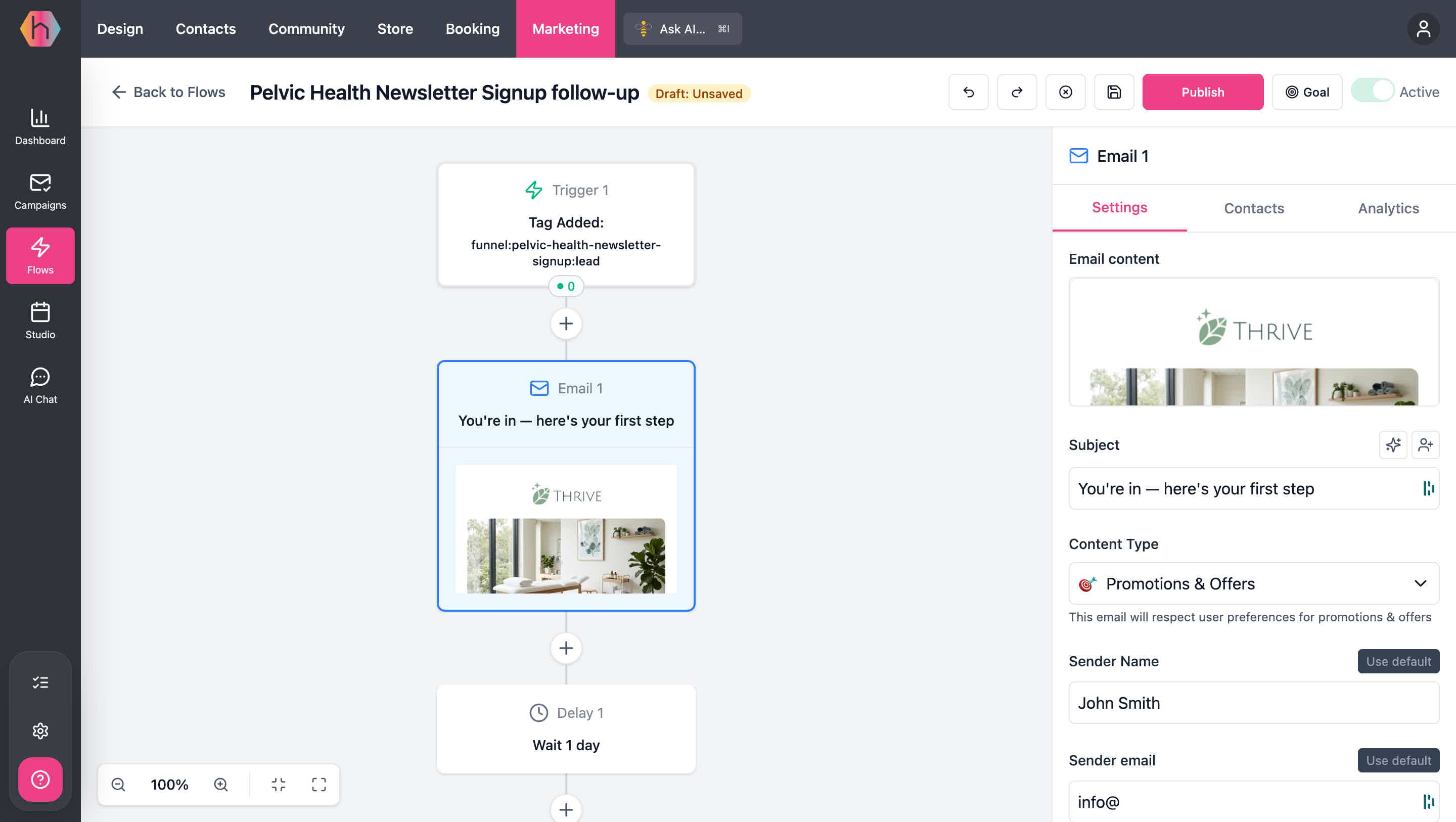
Compare that with assembling it yourself: a phone AI vendor, a text-back workflow, an SMS provider, a CRM integration, and a booking integration, each a place for a lead to fall through. If you're weighing the standalone route anyway, our AI receptionist buyer's guide compares the leading tools honestly.
How to roll this out without scaring anyone
A sensible adoption path we see practices take:
Week 1: measure. Pull your call log and count unanswered and after-hours calls. Our missed-calls calculator turns that into a dollar figure.
Week 2: turn on text-back. Zero risk, immediate recovery of some lost callers, and your team gets used to SMS threads appearing as contacts.
Week 3: test the AI privately. Call the AI number yourself with your ten most common questions. Adjust the greeting and knowledge until you'd be happy for a patient to hear it.
Week 4: forward after-hours only. Let the AI own evenings and weekends first, the hours where the alternative is voicemail and the bar is lowest.
Then: full forwarding. Once the transcripts have earned your trust, let it answer whenever your team can't.
Frequently asked questions
Is missed call text back enough on its own?
It is better than nothing by a wide margin, and if you truly cannot answer more calls, start there. But you are still losing the majority of missed callers, and the ones you recover start with an apology. It is a floor, not a solution.
Will patients be annoyed by an automatic text?
Rarely, if the text is prompt, polite, and useful ("Sorry we missed you! Want to book here, or text us back?"). It reads as responsive, not robotic, especially compared to silence.
Does an AI answering the phone feel impersonal?
The large-scale data says callers engage well when the AI discloses what it is and actually helps. What feels impersonal is voicemail. What loses patients is ringing out.
Can I start with text-back and add AI answering later?
Yes, and it is a sensible on-ramp if you want to build trust gradually. In Hiveality both live in the same system, so turning on full AI answering later is a switch, not a migration.
The bottom line
Missed call text back is what you settle for when nothing answers the phone. In 2026 something can answer the phone. Run the receptionist as your front line, keep text-back as the safety net beneath it, and stop paying for missed calls in either apologies or silence.
Related Posts

How Many Patients Is Your Practice Losing to Missed Calls?
The uncomfortable math: a large share of calls to appointment-based practices go unanswered, most callers won't leave a voicemail, and each lost caller is a patient with real lifetime value. Run your own numbers.

The Best Email Marketing for Health Coaches (2026)
Email is the health coaching business. Hiveality, Kit, ActiveCampaign, and Mailchimp honestly compared against the five jobs a coach's email actually does: capture, nurture, segment, launch, and stay consistent.
10 Proven Ways to Grow Your Clinic's Email List in 2026
Ten list-growth strategies that still work in 2026, ranked by effort and payoff: quizzes, intake integration, pop-ups done politely, referral loops, and the segmentation that makes the list worth having.